Monthly Archives: November 2022

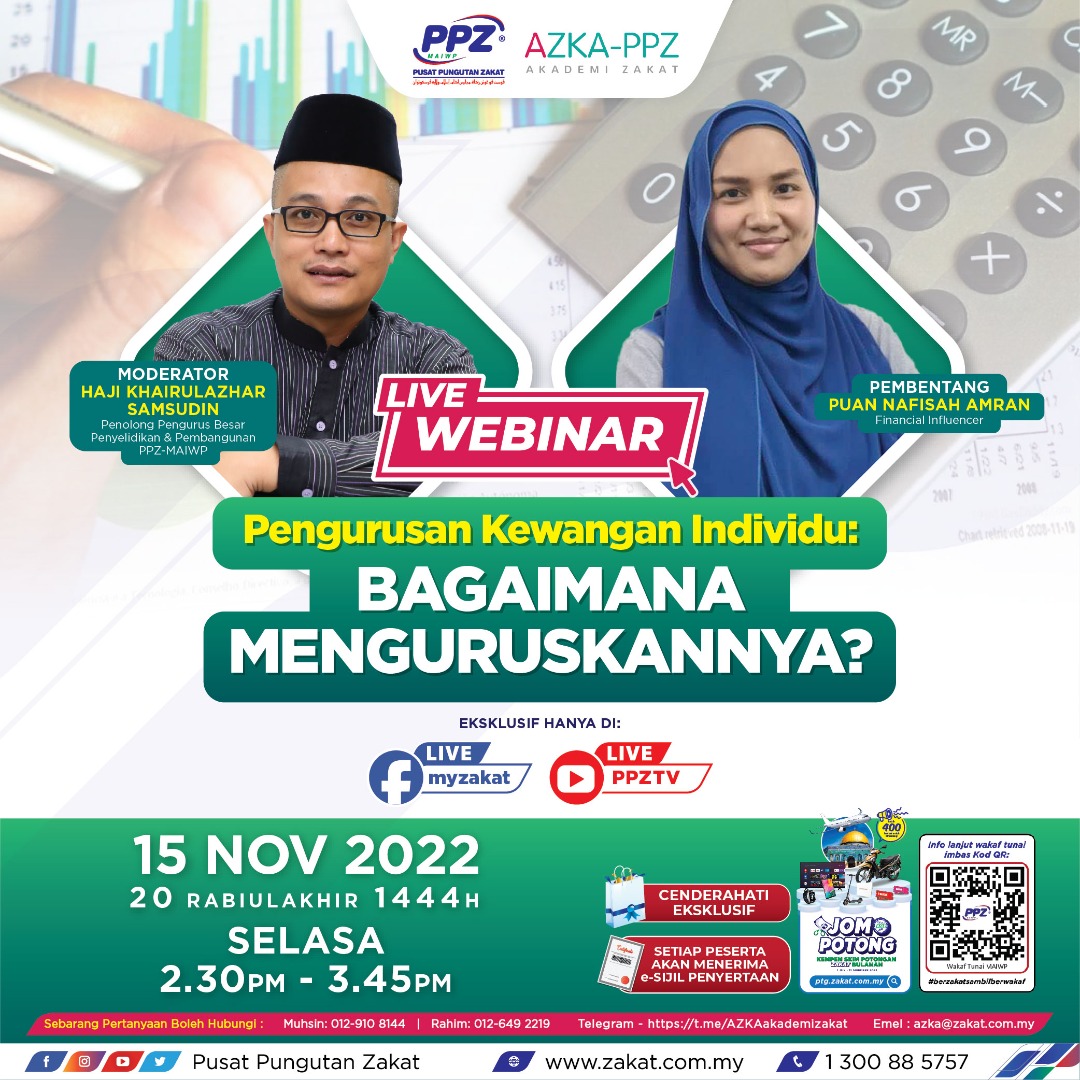
AZKA Live Webinar Pengurusan Kewangan Individu: Bagaimana Menguruskannya?

  • November 24, 2022
  • Comments off

Good financial management is a very important for every individual. Financial management requires knowledge, patience and perseverance and must always practice to succeed. The way we make financial decisions is influenced by various factors. Each individual must understand their strengths and weaknesses to adapt financial behavior to align with the goal of financial management. For example, if we want to retire comfortably, we need to save, not overspend and manage finances accordingly. This goal requires long-term planning and self-discipline to make lifestyle changes. Let’s watch the Live Webinar Pengurusan Kewangan Individu: Bagaimana Menguruskannya? presented by Mrs Nafisah Amran, Financial Influencer and Mr. Haji Khairulazhar Samsudin, Assistant General Manager Research & Development, Pusat Pungutan Zakat-MAIWP as moderator. Download Paper Presentation Pengurusan Kewangan Individu: Bagaimana Menguruskannya? Pengurusan Kewangan Individu: Bagaimana Menguruskannya? -Mrs Nafisah Amran- DOWNLOAD Lets Watch Live Webinar Technology Blockchain Based on Smart Contracts in Ensuring the Effectiveness and Transparency of Zakat Collection

Read More
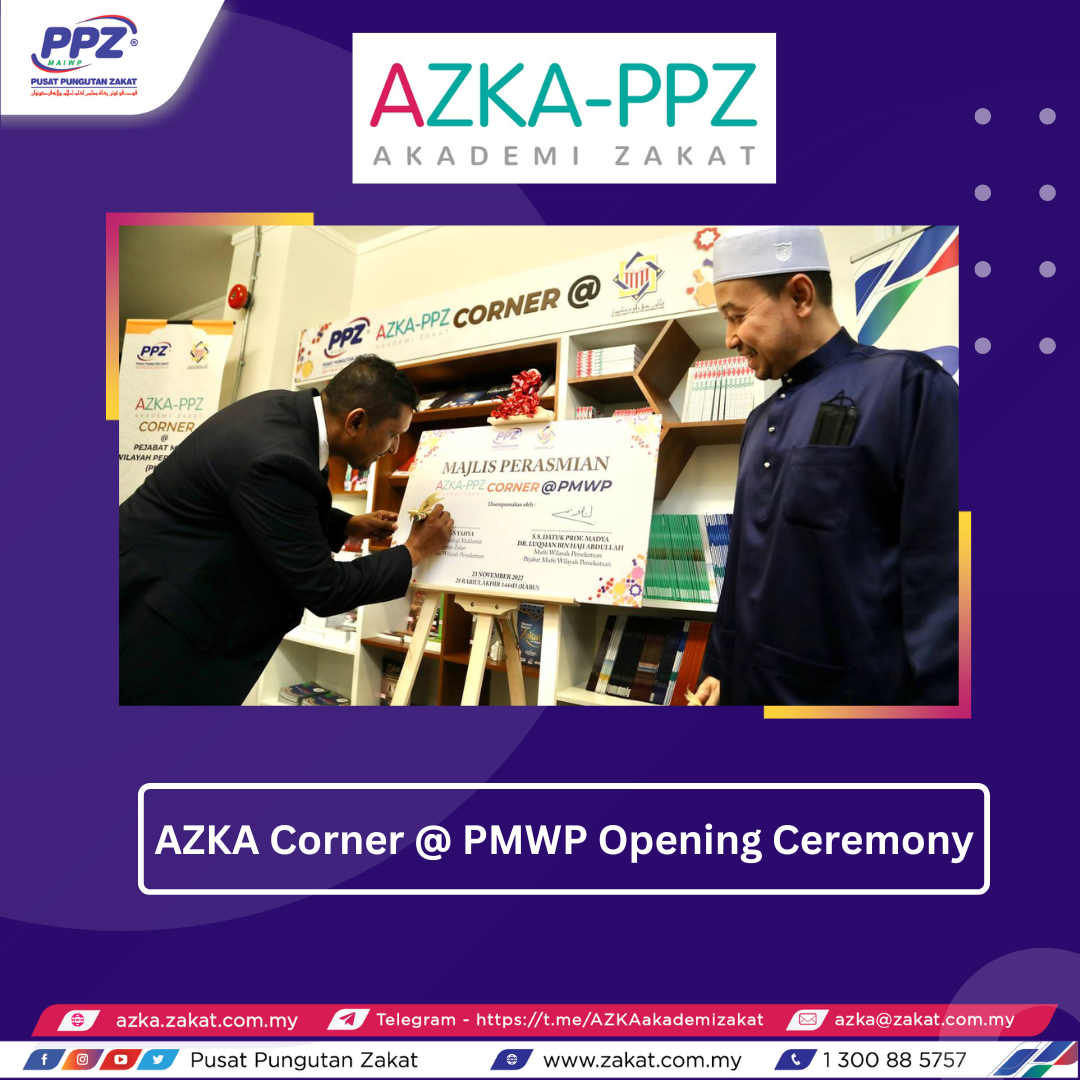
AZKA Corner @ Pej. Mufti Wilayah Persekutuan Opening Ceremony

  • November 23, 2022
  • Comments off

On November 23rd, 2022, AZKA marked another significant milestone to its extraordinary journey today with the establishment of the 8th AZKA Corner. The Grand Opening Ceremony of the departments was held on this day from 10.00 am to 12.00 pm at Pejabat Mufti Wilayah Persekutuan. This prestigious occasion was honored by the presence of the Sahibus Samahah Datuk Prof. Madya Dr. Luqman bin Haji Abdullah and General Manager Information Communication Technology PPZ-MAIWP, Haji Norman bin Yahya. The 8th AZKA Corner has started operating in March 2022.

Read More

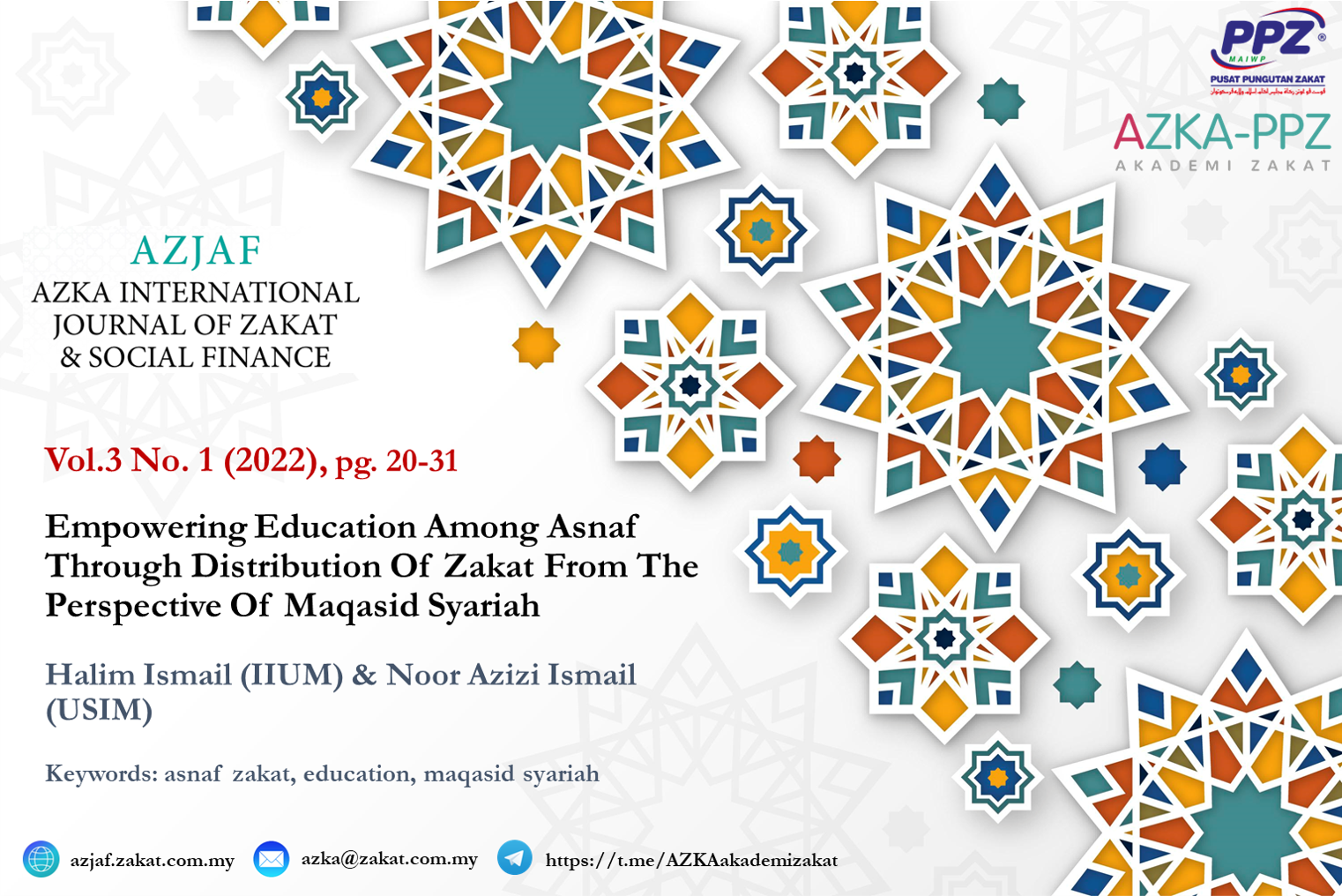
AZJAF’s Highlight #2 – Empowering Education Among Asnaf Through Distribution Of Zakat From The Perspective Of Maqasid Syariah.

Title: Empowering Education Among Asnaf Through Distribution Of Zakat From The Perspective Of Maqasid Syariah. Author:Halim Ismail (IIUM) & Noor Azizi Ismail (USIM) Abstract:This study examines the empowerment of education among the asnaf through the distribution of zakat according to the perspective of maqasid syariah. This study presents the debate of scholars regarding the distribution of zakat to strengthen the education of asnaf and its implementation in Malaysia. This study was conducted using content analysis methods through deductive, inductive, and comparative methods. Studies show that, through the perspective of maqasid syariah, the distribution of zakat to asnaf can increase the level of education of this group. Keywords: asnaf zakat, education, maqasid syariah Read full article: https://doi.org/10.51377/azjaf.vol3no1.92  

Read More

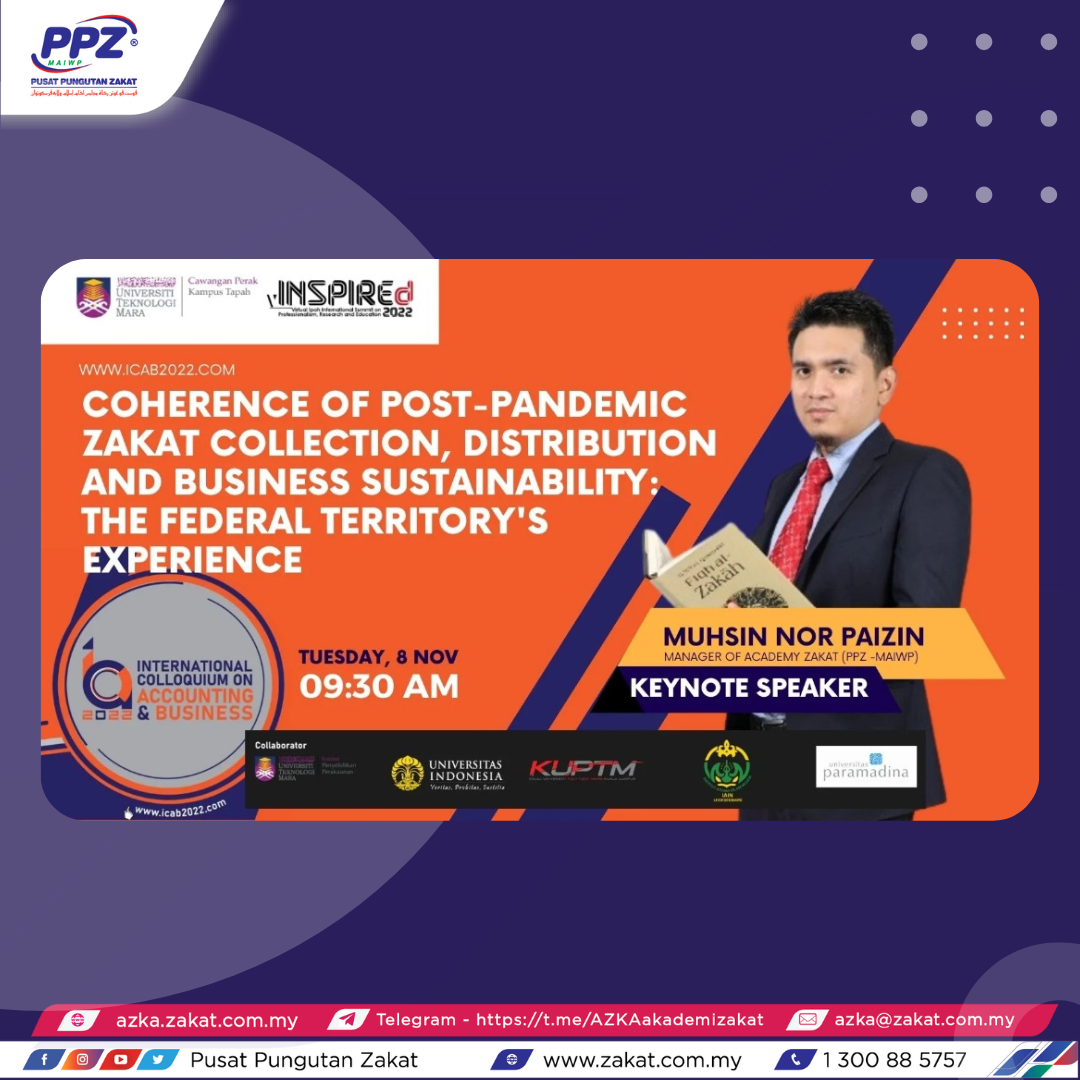
International Colloquium on Accounting & Business 2022

  • November 8, 2022
  • Comments off

ICAB2022 is the 1st International Colloquium on Accounting and Business, which is organized by the Faculty of Accountancy, UiTM Perak Branch, Tapah Campus in collaboration with the Accounting Research Institute (ARI), Universitas Paramadina, Universitas Indonesia, Kolej Universiti Poly-Tech Mara (KUPTM) andInstitute Agama Islam Negeri Iain Lhokseumawe. This colloquium is held on 8-9 November 2022 with thetheme ‘Accounting and Business Resilience in a Post-Pandemic Economy’. It is open to those who are interested in learning new knowledge as well as to those who want to share their own practices. The objective of ICAB2022 is to provide a platform for academics, professionals, researchers and scholars from Malaysia and abroad to interact and share knowledge, experience and expertise in the fields of accounting, finance, economics and business management. AZKA Manager had a chance to participate in this ICAB 2022 as key note speaker during 1st day of session. The title presentation is Coherence of Post Pandemic Zakat Collection, Distribution and Business Sustainability: The Federal Territory’s Experience. This 2 days program conducted through online platform using Zoom Download eProceeding 1st International Colloquium on Accounting and Business (ICAB 2022) eProceeding 1st International Colloquium on Accounting and Business (ICAB 2022) DOWNLOAD

Read More

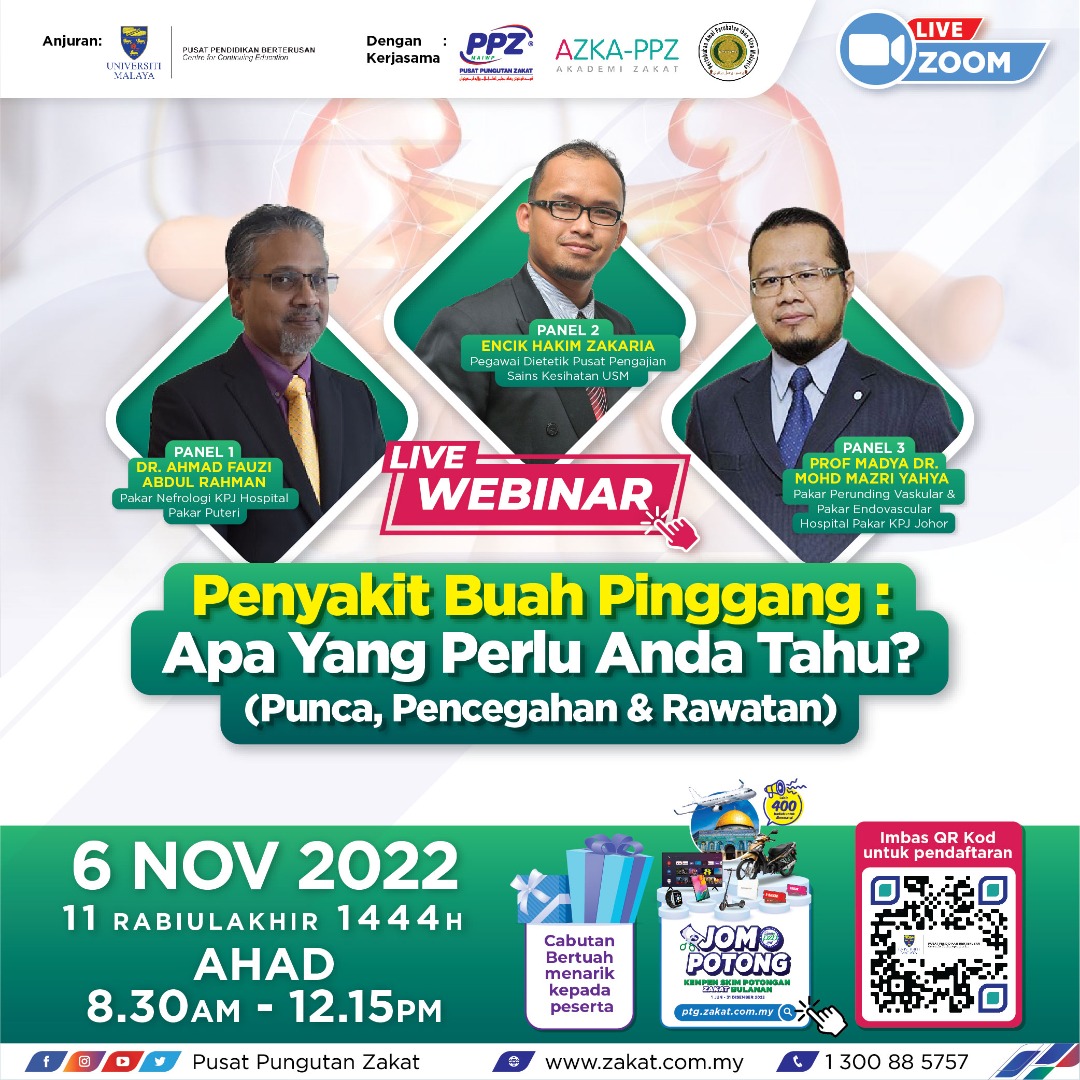
AZKA Live Webinar Penyakit Buah Pinggang Apa Yang Perlu Anda Tahu

  • November 6, 2022
  • Comments off

Chronic kidney disease, also called chronic kidney failure, involves a gradual loss of kidney function. Your kidneys filter wastes and excess fluids from your blood, which are then removed in your urine. Advanced chronic kidney disease can cause dangerous levels of fluid, electrolytes and wastes to build up in your body. In the early stages of chronic kidney disease, you might have few signs or symptoms. You might not realize that you have kidney disease until the condition is advanced. Treatment for chronic kidney disease focuses on slowing the progression of kidney damage, usually by controlling the cause. But, even controlling the cause might not keep kidney damage from progressing. Chronic kidney disease can progress to end-stage kidney failure, which is fatal without artificial filtering (dialysis) or a kidney transplant Let’s watch the Live Webinar  Penyakit Buah Pinggang Apa Yang Perlu Anda Tahun (Punca, Pencegahan dan Rawatan) presented by Dr. Ahmad Fauzi Abdul Rahman, Pakar Neurologi KPJ Hospital Pakar Puteri, Mr. Hakim Zakaria, Pegawai Dietetik Pusat Pengajian Sains Kesihatan USM and Prof. Madya Dr. Mohd Mazri Yahya, Pakar Perunding Vaskular & Pakar Endovascular Hospital Pakar KPJ Johor.  Lets Watch Penyakit Buah Pinggang Apa Yang Perlu Anda Tahun (Punca, Pencegahan dan Rawatan) AZKA Live Webinar Penyakit Buah Pinggang Apa Yang Perlu Anda Tahun (Punca, Pencegahan dan Rawatan) CLICK

Read More

Chapter 7 The Role Of Waqf In Socioeconomic Development In Ottoman Empire: Lessons For Nigeria

  • November 2, 2022
  • Comments off

DOWNLOAD CHAPTER 7 The Role Of Waqf In Socioeconomic Development In Ottoman Empire: Lessons For Nigeria Abstract Islam has attached many values to human life and put in place different measures to help in achieving the two lives. The religion out of its utmost keenness to create an avenue for Islamic welfare state and financial inclusion, institutions have been established to cater for the welfare of humanity. Waqf is one of the institutions that have been created for the protection of the needy, the poor, the family and the society at large. Its legitimacy is sourced from primary and secondary sources of Shari`ah. Personal assets can be endowed for educational, health, public uses or any other benevolent purpose under specific terms and conditions. In line with this, Waqf has vigorously played a vital role in socioeconomic development right from the infancy stage of the divine message. It`s historical event of establishment started right in the time of Prophet Muhammad SAW when the very first mosque (as multipurpose Islamic centre) was built by the prophet in Madinah on a parcel of land endowed by two orphans. The evolutionary trend has continued to make headway through multifarious Islamic eras to meet the basic societal needs. This paper seeks to review literatures on the track record of Waqf with regards to socioeconomic development. In order to achieve this objective, content analysis and historical method were adopted to review the related literatures from secondary data such as articles from journals, books and manuscripts. It is recommended that there should be a national Awqaf board to enhance the socioeconomic development status in Nigeria. Keyword: Waqf, Socioeconomic, Development, Ottoman Empire. Share: Facebook Twitter LinkedIn Writer Umar Muhammad Aljazira Federal University Dutsin-Ma, Nigeria. Ahmad Muhammad Gusau Federal University Dutsin-Ma, Nigeria. Jabir Musa Sulaiman Federal University Dutsin-Ma, Nigeria.

Read More

Chapter 6 Empowerment Of Asnaf Zakat Through Zhul-Qarnain Community Engagement Model

  • November 2, 2022
  • Comments off

DOWNLOAD CHAPTER 6 Empowerment Of Asnaf Zakat Through Zhul-Qarnain Community Engagement Model Abstract The increasing quest for sustainable empowerment intervention for the zakat Asnaf has been generating concerns among scholars and policymakers in recent times. One-off zakat assistance for the Asnaf zakat especially the needy and the poor in the contemporary is recommended to alleviate the immediate needs of the recipients, however, there is a dire need in the contemporary time for sustainable empowerment intervention for the Asnaf zakat. This study aims to explore what and how the Zhul- Qarnain community engagement model can be a useful and sustainable approach toward the empowerment of the Asnaf zakat in contemporary Muslim society. The study is qualitative-based research that explores the inductive approach of extracting classical literature and contemporary research work on the importance of empowerment of the asnaf zakat, the significance of the Zhul-Qarnain community engagement model, and its relevance to the empowerment of Asnaf zakat in the modern era. The study will illustrate an interpolative relevance of the Zhul-Qarnain model to solving the challenges of asnaf zakat. The study proposes a sustainable empowerment model for asnaf zakat through the Zhul-Qarnain community engagement model. This study suggests a specific niche for advanced study on the sustainable empowerment model for asnaf zakat. Keyword: Empowerment, Zakat Asnaf, Zhul-Qarnain, CommunityEngagement. Share: Facebook Twitter LinkedIn Writer Saheed Abdullahi Busari International Islamic University, Malaysia

Read More

Chapter 5 Zakat As An Effective Strategy For Poverty Alleviation In Zanzibar

  • November 2, 2022
  • Comments off

DOWNLOAD CHAPTER 5 Zakat As An Effective Strategy For Poverty Alleviation In Zanzibar Abstract It is well known that the basic objective of paying Zakat is to create a balance in the society and never let a poor and needy suffer or die. In simplicity, the wealth is transferred from the hands of rich to poor in order to stabilize economic condition of the society and ensures that each person is benefitted from the wealth. The main purpose of this paper is seen how zakat is used as an Islamic instrument for poverty alleviation in Zanzibar. A quantitative approach was used in this study where a samplesize of 287 head of households was used. A survey questionnaire was used as data collection instrument. To achieve a credible study, Structural Equation Modelling (SEM), based on maximum likelihood estimation, and relevant analyses were used to analyse the collected data from relevant respondents. The results indicate that people have access to and uses of zakat fund but there is no any impact on their quality of life due to several challenges such as low amount of distribution and poor management ofzakat fund. The study has offered several recommendations with regard to the means and practices of poverty alleviation in Zanzibar via Zakat fund. Keyword: Zakat Fund, Accessibility and Uses and Poverty alleviation Share: Facebook Twitter LinkedIn Writer Abdalla Ussi Hamad Zanzibar University, Tanzania.

Read More

Chapter 4 Misconception Of Zakat And Distributive Justice In Islam: Case Study Of Zakat Institutions In Malaysia

  • November 2, 2022
  • Comments off

DOWNLOAD CHAPTER 4 Misconception Of Zakat And Distributive Justice In Islam: Case Study Of Zakat Institutions In Malaysia Abstract The COVID-19 pandemic caused a multidimensional crisis in health, economic, social, and lifestyle due to the pandemic. Many people endured hardships and struggled to make ends meet. As an Islamic social fund, zakat plays a role in mitigating this problem by assisting communities affected by it. This study investigates the role of zakah and addresses the issues related to zakat misconceptions and management by demonstrating the importance of zakat through various evidence undertaken by zakatinstitutions during the pandemic. This study adopts a qualitative research method using secondary data and analytical approaches to achieve its objectives. Zakat distribution programmes conducted by all zakat institutions in Malaysia for zakat beneficiaries affected by Covid-19 have been one of the study’s most important findings. This highlights the viability of zakat objectives as one of Islam’s distributive justice mechanisms in assisting and alleviating the burden imposed on society,particularly those in the asnaf categories due to the Covid-19 pandemic. The study is limited to the focus on the zakat mechanism in the context of distribution justice from the Islamic perspective. Keyword: Zakah, Viability, Misconception, Covid-19 Share: Facebook Twitter LinkedIn Writer Siti Saffa’ International Islamic University, Malaysia Syed Marwan International Islamic University, Malaysia

Read More

Chapter 3 Social Protection From Islamic And Western Socioeconomic Perspectives: A Comparative Review

  • November 2, 2022
  • Comments off

DOWNLOAD CHAPTER 3 Social Protection From Islamic And Western Socioeconomic Perspectives: A Comparative Review Abstract This paper discusses the topic of social protection in terms of social security and insurance. It is further narrowed into two aspects. The first one is how social protection helps the needy, and the second is how social protection helps economic growth. The paper starts with information on social security and insurance from Islamic and conventional points of view. The differences between these two views are elaborated more in this paper. Furthermore, a list of scholars from the Islamic and the western worlds and their contributions to social security and insurance are highlighted despite their philosophical and geographical differences. The three Islamic scholars are Muhammad Yunus, who came out with microfinance to help the poorest of the poor. Followed by Ungku Abdul Aziz, who brought the establishment of Tabung Haji and lastly, Caliph Umar ibn Abdul Aziz in the past, where during his caliphate, the management of the leading social protection instrument was zakat, which was on top of the extent that there were no poor people who were eligible to receive the funds of zakat. On the other hand, this paper also provides some information on the contributions of conventional scholars to see how these two systems differ from one another and how they can integrate into benefiting each other. The first conventional scholar is Otto Von Bismarck, who introduced the first social insurance and invented a pension fund—followed by Roosevelt, who used his presidential power to enact a law related to social security. Willian Beveridge, a British economist and social reformer is the last one. He was closely associated with the development of state welfare and published a report entitled ‘Social Insurance and Allied Services’ to cure the problem faced by society. Providing all these scholars indicates a need to discuss the integration of contributions to this field that supports social benefit to the needy and helps grow the economy. Further analysis and recommendations are presented regarding this topic in the last section of the paper. Keyword: zakat, social security, social protection, insurance, pension Share: Facebook Twitter LinkedIn Writer Amani Binti Muhammad International Islamic University, Malaysia. Mohamed Aslam Akbar International Islamic University, Malaysia.

Read More