Monthly Archives: December 2021

PPZ-MAIWP dan LZNK Berganding Bahu

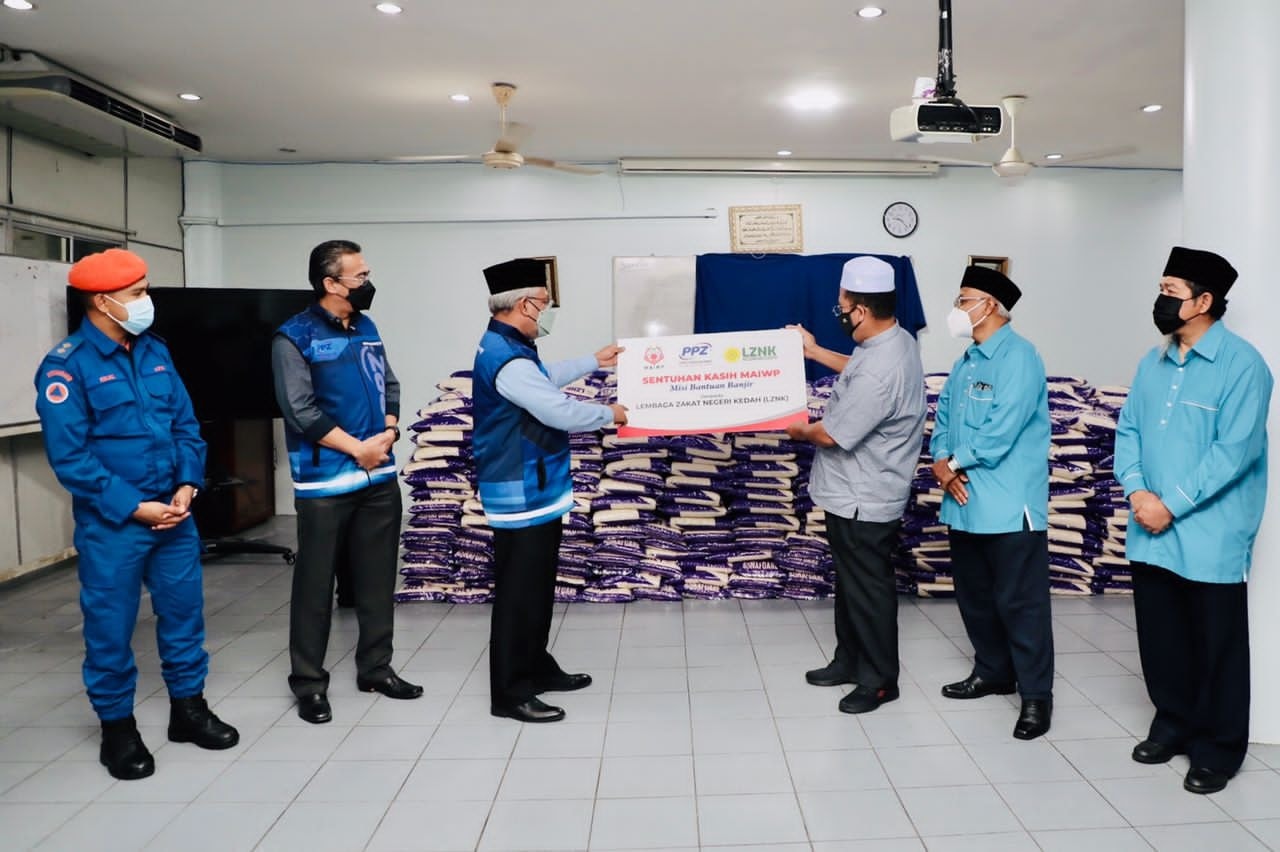
Alhamdulillah, Program Sentuhan Kasih MAIWP mendapat kerjasama daripada Lembaga Zakat Negeri Kedah Darul Aman yang telah menyumbang 6000 kampit beras untuk kami agihkan kepada mereka yang terlibat dengan musibah banjir di Wilayah Persekutuan. TERIMA KASIH kepada Syeikh Zakaria Bin Othman, CEO Lembaga Zakat Negeri Kedah yang turut hadir bagi menyerahkan sumbangan ini. Kepada individu mahupun syarikat yang ingin berkongsi rezeki bersama asnaf boleh salurkan zakat anda kepada PPZ-MAIWP. Salurkan zakat anda secara atas talian mengikut 6 pilihan saluran seperti di dalam link ini: http://bit.ly/saluranzakat

Read More

Karikatur Ustaz Amil No. 7

Barangsiapa memiliki dua nikmat ini (waktu lapang dan nikmat sihat), hendaklah ia mensyukurinya dengan melaksanakan segala perintah dan menjauhi setiap larangan Allah. Barangsiapa yang tidak bersyukur, maka dialah orang yang tertipu. Semoga Allah selalu memberi kita taufik dan hidayah-Nya untuk memanfaatkan dua nikmat ini dalam ketaatan. Semoga kita tidak termasuk orang-orang yang tertipu dan terperdaya. ~Karikatur Ustaz Amil No. 7~____________________________________ PPZ-MAIWP sedang mengadakan Kempen Year End Zakat 2021 bermula 15 November hingga 31 Disember 2021. Lebih 1,200 hadiah ditawarkan kepada pemenang yang bertuah. Mohon sahabat-sahabat semua dapat menguar-uarkan kempen ini kepada sahabat handai & kenalan. Maklumat lanjut boleh layari portal PPZ www.zakat.com.my/yez2021 #KempenYEZ2021#PPZMAIWP#PusatPungutanZakat#MemudahkanAndaBerzakat#BerdiriBersama

Read More

Impact of Zakat on the Muslim

  • December 23, 2021
  • Comments off

There is no doubt that Zakat (obligatory charity) has a great impact on both the person who pays it and on society as a whole. Among its impacts are the following: It purifies the person who gives it from sins and acts of disobedience he committed; Allah Says (what means): {Take, [O Muhammad Sallallahu `Alayhi wa Sallam (may Allah exalt his mention) ], from their wealth a charity by which you purify them and cause them to increase.}[Quran 9:103]. Moreover, it is confirmed that the Prophet Sallallaahu `Alayhi wa Sallam (may Allah exalt his mention) said: “Charity wipes out the sin exactly as water extinguishes the fire.” [At-Tirmithi] It results in the increase and blesses of the money; linguistically, Zakat means to bless, increase, or purify. Allah Says (what means): {But whatever thing you spend [in His cause] – He will compensate it, and He is the best of providers.}[Quran 34:39]. Besides, it is confirmed that the Prophet Sallallaahu ‘Alayhi wa Sallam (may Allah exalt his mention) said: “I swear by Allah on the following three things: ….(and he mentioned) charity does not decrease the wealth of the person who gives it.” [At-Tirmithi] It fulfills the need of the needy; this leads to the spread of security in society, as theft and robbery will decrease. It also means harmony in society. The above are some fruits yielded by the payment of Zakat, and whoever wants to find out more in this regard may refer to the books of the scholars may Allah have mercy upon them on this subject. Allah Knows best.

Read More

Why We Should Purify Our Wealth?

  • December 23, 2021
  • Comments off

Why it is important that we should ‘purify’ our wealth and what is the significance of zakat? In Islam, all wealth belongs to Allah. It does not belong to the individual. Wealth is an amanah (trust that is entrusted to the individual) from Allah. We are but the administrator of it. We will have to account for the wealth that Allah has entrusted to us in the Hereafter. Allah has made it obligatory on us that a very small part only 2.5 percent of the wealth He entrusted us with must be paid as zakat. This 2.5 percent does not belong to us. It belongs to the poor and the needy and those who can receive it. The poor and the needy have the right to demand the due zakat from the wealthy. When a Muslim gives the zakat, Allah, through His Love and Mercy, makes the rest of his wealth which is the remaining 97.5 percent halal (lawful) for him to use as he pleases. Allah encourages him to spend a portion of his 97.5 percent in charity (sadaqah) but He does not make it obligatory or compulsory. In giving zakat, a person purifies his soul from the filth of miserliness, greed, and selfishness. It cleanses his soul from feeling contempt for the poor. It stops him from behaving harsh-heartedly towards the poor. It nurtures in him feelings of spiritual goodness which include compassion, concern, and understanding for the poor. It ensures that the giver will receive the Blessings of Allah in the Hereafter. One of the main aims of zakat is to eradicate poverty (al-faqr). Allah, due to His all-encompassing Knowledge and Mercy, knows that it will be difficult for a person to perform his obligatory duties, personal, spiritual, social, political, and otherwise when he is starved of food and deprived of shelter. Thus performing zakat will help them. Allah knows best!

Read More

On Increasing Good Deeds

  • December 23, 2021
  • Comments off

All praise is due to Allah. He made the Quran a beacon of light for its readers. He also made the prayers a source of comfort for worshipers and the charity a rewarding trade for those who spend in the cause of Allah. Reciting Al-QuranPlease know that the faithful believers who run a beneficial trade, recite the Quran in days and nights, establish prayers to please their Lord, and spend from their wealth in private and in public shall, by Allah’s grace, see their good deeds increased in amounts they could barely imagine. They shall also expect their sins to be forgiven and some of their good deeds to be appreciated. The Almighty says: “Indeed, those who recite the Book of Allah and establish prayer and spend [in His cause] out of what We have provided them, secretly and publicly, [can] expect a profit that will never perish That He may give them in full their rewards and increase for them of His bounty. Indeed, He is Forgiving and Appreciative.” [Al-Quran, Surah Al-Fatir, verse 29-30]. This verse starts with a reference to reciting the Quran, in an indication of its great standing. Indeed, it is amongst the most rewarded trades and one of the worships that bring us closer to Allah, the Most Exalted. For this reason, in the following verse, Allah enjoins His Messenger to recite the Quran; He says, “Recite, [O Muhammad], what has been revealed to you of the Book and establish prayer.” [Al-Quran, Surah Al-Ankabut, verse 45]. Allah revealed His holy Quran for us to read and ponder over its meanings. He says, “[This is] a blessed Book which We have revealed to you, [O Muhammad], that they might reflect upon its verses and that those of understanding would be reminded.” [Al-Quran, Surah Sad, verse 29]. Indeed, for each letter of the Quran we read, we will attain multiple rewards. This was further stressed by the Prophet when he said, “Whoever recites a letter from the Book of Allah will be credited with a good deed, and a good deed gets a tenfold reward. I do not say that Alif Lam Mim is a letter, but Alif is a letter, Lam is a letter and Mim is a letter.” Furthermore, learning the Quran is better for the believer than possessing treasures and great wealth. The Prophet said in this regard, “if anyone of you goes out in the morning to the mosque and learns two verses of the Book of Allah, the Exalted, it is better for him than two she-camels, and three verses are better for him than three she-camels, and four verses are better for him than four she-camels, and so on than their numbers in camels.” It is, then, such a great thing that we engage in learning the Quran and teaching it to our children. Abdullah ibn Masood said in this regard, “this Quran is the Banquet of Allah. So, learn as much as you can from it. Indeed, understanding comes through learning.” So, when we read the Quran, Allah, the Almighty, will, in fact, witness over our recitation and listen to it as evidenced in this verse, “And, [O Muhammad], you are not [engaged] in any matter or recite any of the Quran and you [people] do not do any deed except that We are witness over you when you are involved in it.” [Al-Quran, Surah Yunus, verse 61]. That is: Allah sees you and hears what you read. Another great virtue of reciting the Quran is that on the Day of Judgment, the one who is devoted to the Quran will be told, “Recite and ascend (in ranks) as you used to recite when you were in the world. Your rank will be at the last verse you recite.” Do PrayPlease also know that observing prayer is one of the strongest and most rewarded acts of worshipping. Allah, the Almighty, ordered us to be steadfast in performing prayers when He says, “Maintain with care the [obligatory] prayers and [in particular] the middle prayer and stand before Allah, devoutly obedient.” [Al-Quran, Surah Al-Baqarah, verse 238]. This verse orders us to perform prayer at its specified time and as required. We must also remain diligent in observing it. It was the last advice from the Prophet to his nation. Ali bin Abu Talib narrated that the last of the Prophet’s words were “Prayer, prayer!” The same was echoed by, Abdullah ibn Masood when he said, “whoever aspires to meet Allah as a Muslim, let him uphold the habit of attending prayers whenever the call to prayer is given. Allah has shown your Prophet the way of guidance, and these prayers (in the mosque) are part of that way.” On another note, you should be aware that whoever performs Wudu’ (ablution) at home well, will be an expiation for the sins he committed prior to it. The Prophet said, “Whoever performs ablution like my present ablution, all his previous sins would be forgiven and his prayer and walking towards the mosque would have an extra reward.” This Hadith advocates that whoever walks to the mosque Allah will raise their status and increase their credits of good deeds. He further stressed the same in another Hadith as he said, “He who purified himself in his house, and then he walked to one of the houses of Allah for the sake of performing one of the obligatory acts enjoined by Allah, both his steps (would be significant) as one of them would obliterate his sin and the second one would raise his status.” As such, a believer goes to prayer and stands in the hands of his Creator pure in heart and body. It is indeed such a great honor to pray amongst the worshipers, bowing with them and standing when they do. Therein, Allah will look over the rows of worshipers to find us humbly submissive and devoutly obedient to Him, fully abiding by His orders and following the guidance of His Messenger. The reward for

Read More

The Wisdom Of Giving

  • December 23, 2021
  • Comments off

Wealth is something that is desired by humans. In attaining wealth, at times friends become foes. Because of wealth, siblings would turn against each other. Due to the greed for wealth, one forgets about halal and haram. While engrossed in attaining wealth, the ibadah (worship) unto Allah gets neglected. These are among the challenges pertaining to wealth. Verily, our wealth or rizq (provision) solely belongs to Allah, which has been predetermined when the soul was blown into the fetus inside the womb. Allah has granted responsibility upon those bestowed with wealth, that a portion of it is to be taken out for zakat, nafaqah (financial support) for the household, sadaqah (charity), orphans, and the need of the community, without delaying it until one become heedless and breathe his last, only to be left with regret. In a hadeeth of Rasulullah that was narrated by ‘Abdullah bin Shikhkhir, he stated that in reality, all wealth belongs to Allah, not mankind. He said: “The son of Adam claims: “My wealth, my wealth!” O son of Adam, is there anything as your belonging except that which you consumed, which you utilized, or which you wore and then it was worn out or you gave as charity and sent it forward?” There are many advantages for the one that makes infaq (charity) from his wealth even though it is deemed that the wealth reduces, but in reality, it is well compensated by Allah. Among the advantages is the increase in one’s rizq. Allah mentions (which means): “Say, “Indeed, my Lord extends provision for whom He wills of His servants and restricts [it] for him. But whatever thing you spend [in His cause] – He will compensate it; and He is the best of providers.”” [Al-Quran, surah Saba’, verse 39]. This verse explains that Allah is The Almighty who can restrict or extend the rizq of His slaves. Whatever spent that is according to the command of Allah, will definitely be recompensed. Abu Hurayrah narrated in a hadith Qudsi that Rasulullah said (which means): “Allah (Mighty and Sublime be He) said: Spend (on charity), O son of Adam, and I shall spend on you.” [Narrated by al-Bukhari] Similarly with the mentioning in the hadith of Abu Hurayrah, where one day Rasulullah entered upon Bilal bin Rabah and saw a container filled with tamr (dates) that is kept by Bilal. He said (which means): “Spend on it, O Bilal! And do not be afraid that it will be reduced by the possessor of the Throne.” [Narrated by at-Tabaraani] In the hadith of Abu Hurayrah, Rasulullah said (which means): “Every day two angels come down from Heaven and one of them says, ‘O Allah! Compensate every person who spends in Your Cause,’ and the other (angel) says, ‘O Allah! Destroy every miser.’” [Narrated by al-Bukhari and Muslim] This means that the one who spends from his wealth as ibadah or to attain nearness to Allah with full sincerity, he will not take it as a loss, deficiency, and poverty. Such is the advantage of those making infaq of their wealth that they have full certainty upon the guarantee by Allah of increased rizq from unexpected sources. Therefore, waqf (endowment) has become a medium for the Companions of the Prophet. Their virtuous practice of competing in making waqf is the direct effect from the teachings of the Prophet. Jaabir stated, “There is no one from among the Companions of Rasulullah who had wealth that did not make waqf.” History has shown that the practice of giving waqf had existed since Rasulullah made Hijrah to Madinah, and it continued throughout the reign of the Khulafa’ ar-Rashidin, the Umayyads, the Abbassids, until the Ottomans. Waqf has become one of the most effective approaches in empowering the Muslim ummah, building public facilities, financing the health and education sector, as well as infrastructures within the city, and many other benefits gained from waqf funds. For example, the Sultan ibn Tulun Hospital in Cairo that was built in the year 872 was the first hospital ever built from waqf fund and also fully administered by the waqf fund. Similarly with the University of al-Qarawiyyin in Morocco that was founded through waqf fund in 859, which was the first university established in the world and had produced prominent graduates such as ibn Rushd who was scholarly in philosophy and medicine. With that, Imam Malik stated, “The latter part of this Ummah will not be rectified except by that which rectified its earliest part.” Alhamdulillah, we are truly grateful to Allah who had bestowed upon us multitudes of provisions. Therefore, after fulfilling our zakat obligation and completing the nafaqah for the household, let us spend a portion of our income as waqf in attaining nearness to Allah and increasing our righteous deeds as provision for the Hereafter. It is befitting for us to take heed from a hadith of the Prophet that was narrated by Abu Barzah al-Aslami, where the Prophet said (which means): “The feet of a slave will not move on the Day of Judgment until he has been questioned about [four things:] his life – how he spent it, his knowledge – how he acted upon it, his wealth – where he earned it and how he spent it, and his body – how he used it.” [Narrated by at-Tirmidhi] To end this point, let us altogether ponder upon the following recommendations, which hopefully has many benefits for us all: The Muslim Ummah must have certainty upon the promise of Allah in bestowing rewards that are manifold and continuous to those that made infaq, for as long as it remains beneficial. The Muslim Ummah must have certainty that giving infaq will not cause the wealth to diminish, but instead, it will further increase. Muslims that have made infaq from their best and most beloved possession will be honored with the greatest appreciation by Allah. Allah said (which means): “Never will you attain the good [reward] until you spend [in the way of Allah] from that which you

Read More

Majlis Menandatangani MoU antara KPBKL dan PPZ-MAIWP (AZKA)

  • December 21, 2021
  • Comments off

Pada 20 Disember 2021, berlakunya satu majlis yang julung kalinya diadakan iaitu menandatangai Memorandum Persafahaman antara Kolej Profesional Baitulmal Kuala Lumpur (KPBKL) dan Pusat Pungutan Zakat (PPZ-MAIWP). Antara tujuan MoU ini adlaah menggalakkan warga KPBKL mendalami ilmu zakat, di samping kerjasama penyelidikan, pembinaan modul baru dalam menyebarluas dakwah zakat. Antara Intipati MoU adalah: Bekerjasama dalam memberi kesedaran pengurusan zakat dikalangan kakitangan KPBKL Menggalakkan kakitangan KPBKL dari semasa ke semasa membuat potongan gaji zakat ke PPZ-MAIWP Menggalakan penyertaan Prog. Pensijilan Profesional AZKA eLearning, iaitu satu kursus tambahan seiring keperluan reskilling dan upskilling sebelum bergraduasi Menggalakkan penyertaan Prog. Pensjilan Profesional di kalangan pensyarah dan kakitangan KPBKL bagi memenuhi Continuing Professional Development (CPD) Mewarwarkan penglibatan pelajar KPBKL mendaftar sebagai Sahabat Zakat PPZ-MAIWP Setiap orang pun boleh turut serta. Jom layari https://www.openlearning.com/azka

Read More

AZKA Corner @ USIM

  • December 19, 2021
  • Comments off

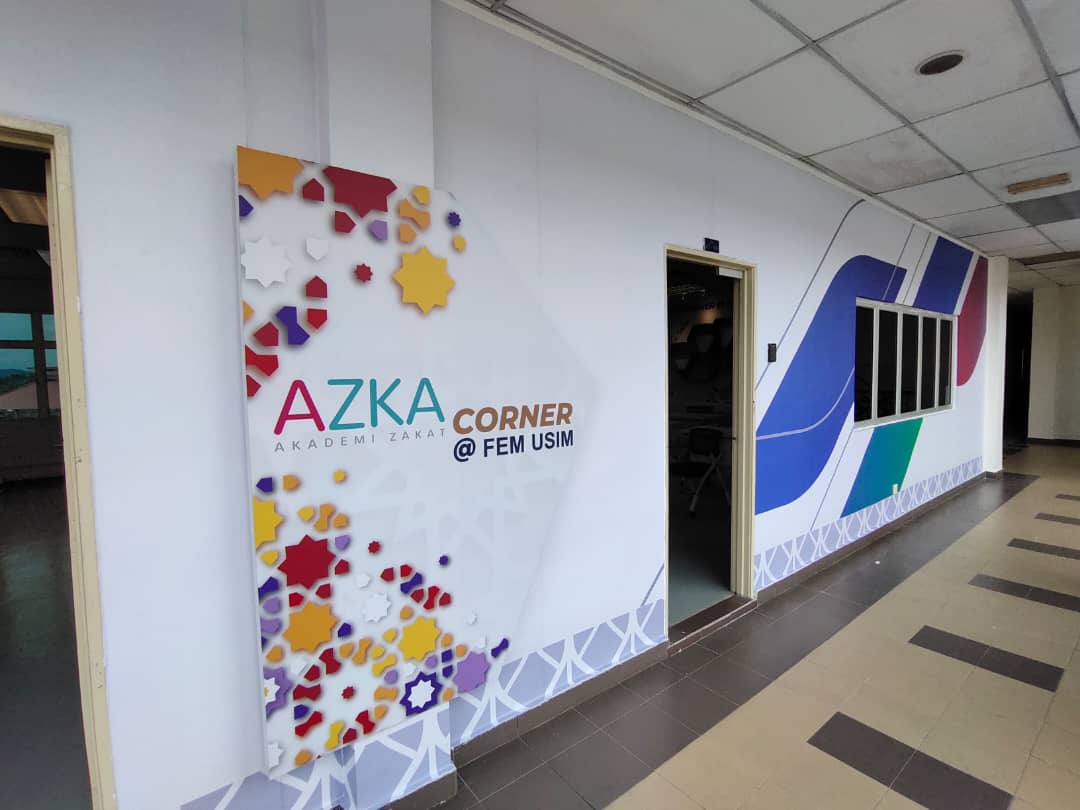
AZKA Corner yang ketujuh ditubuhkan di Fakulti Ekonomi dan Muamalat (FEM) Universiti Sains Islam Malaysia (USIM). Kelainan AZKA Corner di USIM ini adalah selain mewujudkan sudut bacaan, AZKA turut mengangkat dua bilik kuliah siswazah, tingkat 3 di FEM-USIM sebagai bilik angkat bagi AZKA-PPZ. Usaha murni ini merupakan satu usaha demi mengangkat zakat kepada perhatian awam. Ia bertujuan agar pengetahuan tentang zakat dapat sampai kepada golongan pelajar dengan kewujudan sudut bacaan yang dipenuhi dengan buku-buku zakat. Adalah diharapkan agar semua pelajar USIM dapat memanfaatkan sudut bacaaan AZKA Corner serta Bilik Angkat ini dengan sebaiknya dengan membaca dan mengulang kaji buku-buku zakat yang telah disediakan. Sudut bacaan AZKA Corner ini merupakan sudut bacaan yang kedua di luar Wilayah Persekutuan setelah AZKA Corner Universiti Sultan Zainal Abidin (UniSZA), Terengganu.

Read More

AZKA Corner @ UniSZA

  • December 19, 2021
  • Comments off

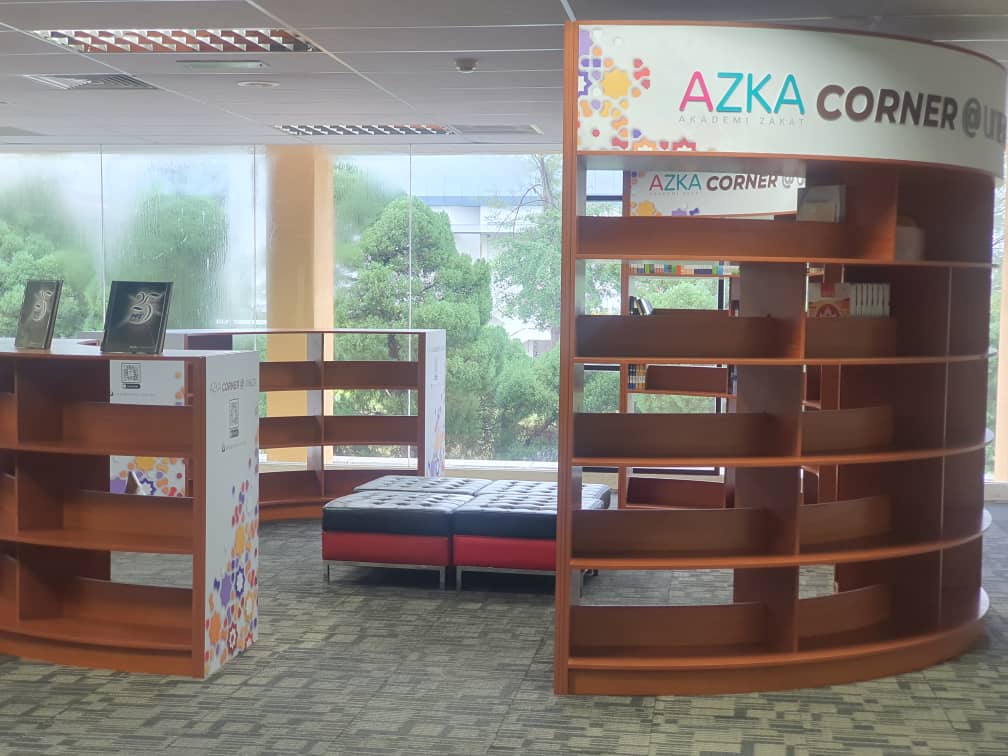
AZKA Corner yang keenam ditubuhkan di Perpustakaan Al-Wathiqu Billah Universiti Sultan Zainal Abidin (UniSZA), Terengganu. Usaha murni ini merupakan satu satu aktiviti kerjasama dengan Institusi Pendidikan Tinggi (IPT) demi mengangkat zakat kepada perhatian awam. Ia bertujuan agar pengetahuan tentang zakat dapat sampai kepada golongan pelajar dengan kewujudan sudut bacaan yang dipenuhi dengan buku-buku zakat. Adalah diharapkan pelajar UniSZA dapat menggunakan sudut bacaaan AZKA Corner ini dengan sebaiknya membaca dan mengulang kaji buku-buku zakat yang telah disediakan. Sudut bacaan AZKA Corner ini merupakan sudut bacaan yang pertama di luar Wilayah Persekutuan.

Read More

Penyerahan Buku Ilmiah Kepada AZKA CORNER@KPBKL

  • December 17, 2021
  • Comments off

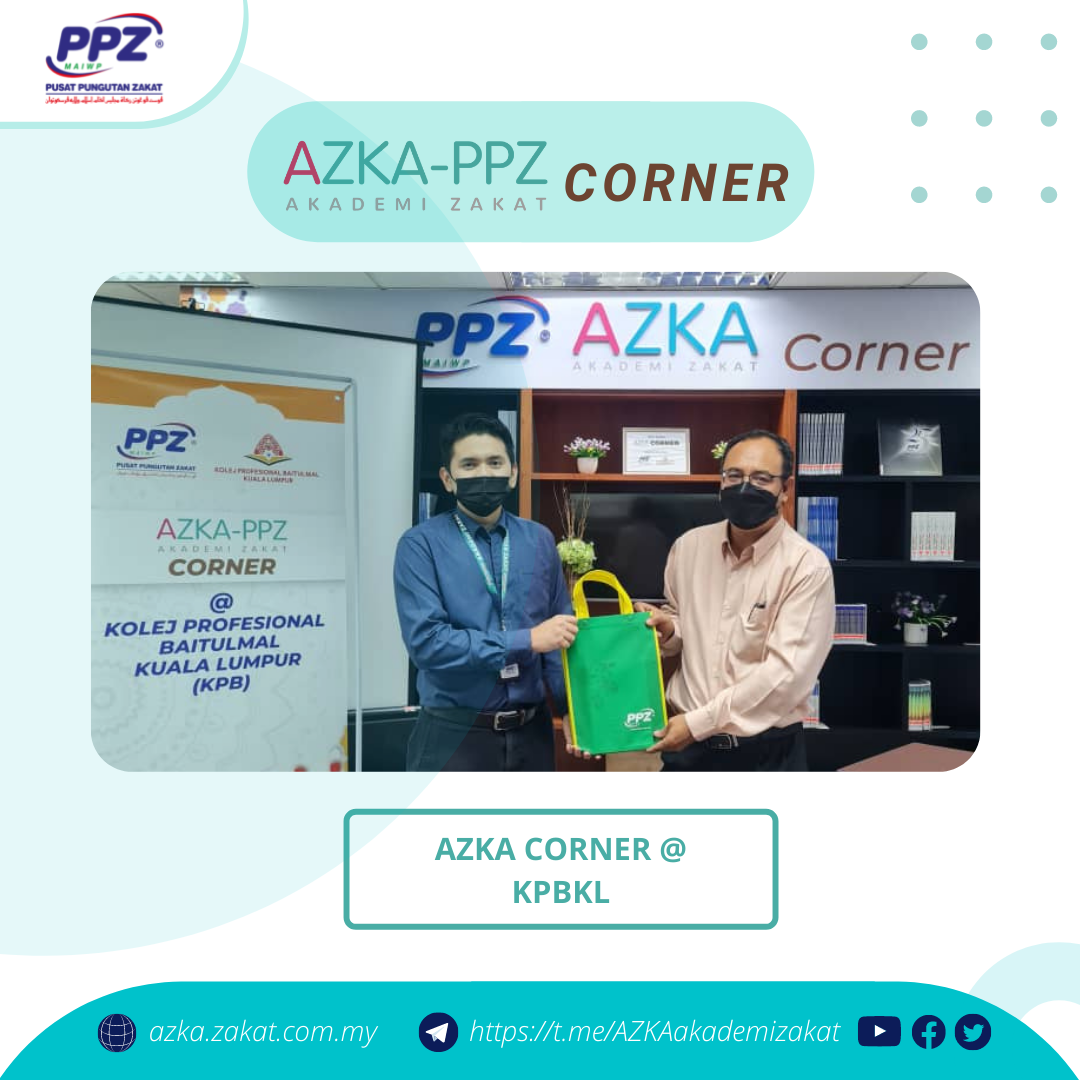
AZKA mengadakan lawatan ke AZKA Corner @ KPBKL bagi menyerahkan sumbangan buku penerbitan PPZ-MAIWP bagi menambah koleksi sudut bacaan AZKA Corner. Adalah diharapkan pelajar Akademi Pengajian Islam Kolej Profesional Baitulmal Kuala Lumpur dapat menggunakan sudut bacaaan AZKA Corner ini dengan sebaiknya membaca dan mengulang kaji buku-buku zakat yang telah disediakan. Layari Laman AZKA Corner@KPBKL untuk mengetahui lebih lanjut tentang AZKA Corner di sini

Read More